When we think of where our food comes from, farms may come to mind, and rightfully so. Farms have been a major source of food for so long that it’s hard to imagine otherwise.
But there is an overlooked alternative: food forests.
According to the U.S. Department of Agriculture’s “Gardening Advice,” more than 50% of the country’s land is used for some type of farming. And though most of this farmland is actually used for grazing livestock, when focusing on edible crops, farms still take almost all of the credit, and are what we rely upon for almost everything we eat.
Even when people, in urban or suburban areas, or with limited space, try to create their own food source, it still tends to look like a miniature farm, although it’s called a “garden.” But even a small backyard garden often lacks two important components: diversity and stability.
This is what a food forest provides, and is what Patrick Snowden, the Resource Conservation Manager and SEA (Students for Environmental Action) club advisor at EvCC, wants to bring to students. “I’ve been involved with environmental stuff for a long time and one of my passions is food insecurity (for) students, and just the general public who have had trouble accessing healthy food.”
Snowden said he first got his inspiration from the small garden in front of Whitehorse Hall. A former EvCC nutrition instructor, the grounds crew and a few others helped to install this garden. “And so that kind of … got my brain going,” Snowden said. “And then I was researching community gardens.”
Growing up, Snowden remembers picking vegetables out of his family’s backyard garden, a result of WWII’s impact on food accessibility; farmers went out to fight during the war, and people had to rely on their own output of fresh food — they were known as “Victory Gardens.” Even now, Snowden has a garden of his own.
“And so I thought I’d try to carry it over here on campus.”
Unlike a normal garden, which is planted based on personal taste and space, a food forest is planted intentionally, with multiple components in mind. The non-profit advocacy group Project Food Forest states it is “a diverse planting of edible plants that attempts to mimic the ecosystems and patterns found in nature.” Because of our long-lasting reliance on farms, most people have forgotten how to use the plants that are already around us for food.
Arguably, with the decrease in forestry (one-third of forests have been destroyed worldwide in the last 10,000 years, according to Our World in Data), that skill slowly faded away. Plus, with the increase in population and urbanization, there has been a tremendous need for alternate food sources in our society.
Snowden recognized this issue. “Young people now, especially folks who aren’t … in a rural environment, they’re in a city; just don’t have access to that kind of thing.”
But these forests can be recreated in non-rural areas, and serve our own needs as well as our environment. “Food forests support forest ecosystems and connect communities with nature,” according to an USDA website post called “Trees and Food Forests.”
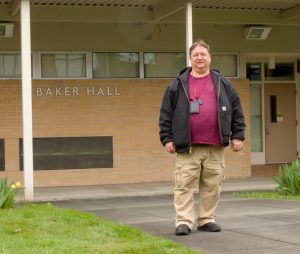
In order to show where the food forest will be situated, Snowden led the way toward Baker Hall. He explained that Baker will be torn down in June and replaced with a lawn of grass and wildflowers.
To the right of the structure, in front of the maintenance buildings, a similar lawn can be seen. But Snowden, in response to this proposal for Baker’s replacement, said that he wanted to bring something more to the school. Even with all the years that have passed, “I never forgot what it was like to be a student, especially a student who … may have a hard time.”
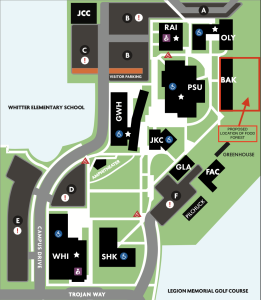
He pointed to the walkway that runs along the covered area of Baker, and explained that steam pipes run underneath which connect to a steam pump located at the maintenance facility. In the early days of EvCC, the whole school was powered by steam, but now with fewer buildings needing it, that source of energy could soon be eliminated, if approved.
Even so, since the underground steam pipes cannot be touched, this leaves Baker’s plot of land and the grass behind it as opportunities for growth.
Snowden explained that once Baker is gone, roughly an acre of land will be available for the forest’s development, which means the potential for a lot of food. With the layering aspect of a food forest, “that helps you get a lot of production out of a small space,” Snowden said.
The Science Mill organization says that there are usually seven different layers in a food forest: the canopy, understory, shrubs, perennials, soil surface, soil/rhizosphere and vertical layer. In each layer, different plants play their own role, creating that balanced ecosystem. “Because of the biodiversity created by this layering, many problems that come up in traditional gardening or agriculture are self-addressed in a food forest,” the Science Mill said. The main issue being avoided includes needing pesticides because of pest insects.
Snowden pointed out that a grass lawn, in place of Baker, would require a lot of maintenance, including pesticides. But the issue of whether a food forest or grass lawn will replace Baker depends on a few timely actions.
A green fee proposal was made by the EvCC administration to hire a landscape architect by July to design the food forest. The green fee is part of students’ tuition, and so this proposal still needs to be approved by the ASB Senate.
Snowden hopes to present this final design to the EvCC administrators, board of trustees along with the student senate; even with approval from the previous two groups, the student leaders have the final say with this project and any other project involving students. “But then we still have to submit it to the city,” Snowden said.
This is where the project could possibly hit a roadblock. “I mean, we just never know,” Snowden said. This level of approval will be much harder, since the land is state-owned, and a permit is required. “So the first step is (to) get a design, (and) jump through all the hoops to get the design going.” Each step of the process is a chance for the project to be denied, but Snowden hopes that, with it being for the students, everyone will see the benefits rather than focus on any difficulties that could arise.
As he pointed out, many colleges have had no problem implementing their own food forests. “This type of concept has actually been on college campuses for a long time.”
Snowden said that Washington has just been a little behind. Being a member of SIC (Sustainable Forestry Initiative Implementation Committee) Washington/Oregon, he was able to learn this first hand, especially when visiting Portland during a SIC event last year. “Oregon has been having food forests for 30 years … and community gardens … on their college campuses.”
Even so, Washington is trying to do its part as well, by implementing food forests and gardens on college campuses. Snowden mentioned Cascadia Community College in Bothell, UW Bothell, Evergreen College and Western Washington University as a few examples. So, when it comes to EvCC, “we’re not inventing the wheel here — it’s been done before,” he said.
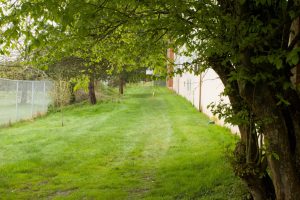
Moving away from Baker, Snowden led the way back toward Parks Student Union, where the walkway connects to Gray Wolf Hall. A group of trees circle a spot of mulch, where a native totem carving of an orca, and a few benches sit.
Snowden said that this area is supposed to be a garden recognizing the indigenous peoples. An EvCC student had formed the idea, but after graduating last year, the project had fallen apart and the garden had been neglected.
That’s the fear Snowden has for the food forest.
“The thing is, you can get something like that installed, but how do you keep it running?”
Snowden and his team are hoping to address this by talking to teachers, and possibly implementing it into a class curriculum, such as nutrition or biology.
If completed, the food forest would not just be a single project — it could also help to inspire similar growth across campus. The indigenous garden is an example of that.
The area has already undergone a cleanup, and the plan is for it to be revived and be primarily focused on growing plants that Native Americans value within their culture.
In two giant stumps, at the edges of the mulch circle, growths of wild blueberries are already appearing.
Snowden’s vision is clear for both projects, especially when it comes to the food forest: areas in which people can sit and talk, a covered area where students can meet, signs with QR codes explaining the various plants, teachers and students alike picking fresh food and washing stations for produce to be cleaned. Snowden wants to see a campus that is connected by nature, food and sustainability.
And it looks as though students across campus support this vision as well.
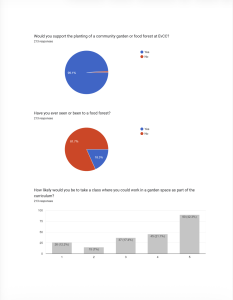
Snowden and his team sent out a survey regarding the food forest, and out of 213 respondents, 99.1% of them said they would support such a project, despite most of them having never heard of a food forest before.
Snowden, having once struggled as a student at EvCC, working part time and taking classes at night, understands what people are going through. “They’re doing their best working, trying to go to school, trying to improve themselves, improve their lives, and yet they’re having a hard time making ends meet.” He wants to help alleviate some of those struggles, especially when it comes to food insecurity.
A project such as the food forest may require city permits, school administration approval and funding. Concerns, such as with security or maintenance may arise, but in the end, it’s meant to be for the students.
“I think, by and large, it’s a doable thing,” Snowden said.
Whatever may occur in the coming months, following the demolition of Baker Hall, he is prepared to take the next steps in pursuing this project and pushing for its success. Backing this plan with the right support from students and administrators alike, Snowden believes strongly that his vision can very well come to fruition.