
The genre of choice-based, narrative games is one that has been held in high regard by gamers and critics alike.
Game studio Telltale games put the genre on the map with critically acclaimed games such as The Walking Dead and The Wolf Among Us. While other companies have made games in the genre like Quantic Dream’s Detroit: Become Human and Supermassive Game’s Dark Pictures Anthology Series, the genre has remained largely dormant since Telltale’s bankruptcy back in 2018.
However, the genre has once again drawn many players’ attention after the release of a new game, Dispatch. Dispatch was created by AdHoc Studio, made up of former employees of Telltales Games, alongside entertainment company Critical Role.
Dispatch follows our protagonist Robert Robertson after he’s forced to retire as the popular Superhero Mecha Man once his suit is damaged beyond repair. Not long after, he is recruited by a company called, Superhero Dispatch Network (SDN) to be a Superhero Dispatcher in charge of the Phoenix Program, which oversees a team of former villains looking for redemption.
In Dispatch, there are three main gameplay segments: Narrative, Dispatching and Hacking. Narrative gameplay involves following the game’s main story and making decisions that will also affect your relationships with other characters. Decisions like disciplining your subordinates’ misbehavior, taking sides in an argument or who you choose to spend time with outside of work will have lasting consequences on your playthrough.
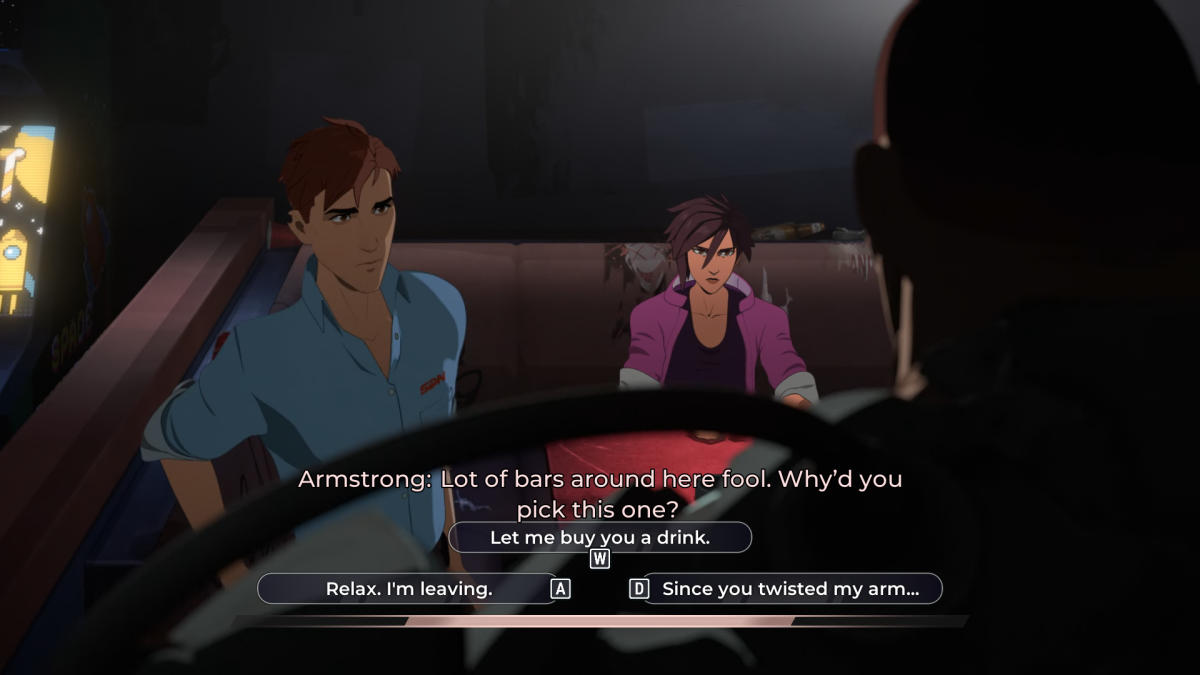
Quick-time events during narrative play allow players to directly interact with the game’s cutscenes.. However, there are only three scenes in which these gameplay segments happen throughout Dispatch’s eight episodes. While the third segment takes up a large amount of the final chapter, it serves as a giant, final fight rather than interacting directly with the game’s story.
Dispatching involves you working at the SDN office awaiting calls requesting the assistance of a hero. The heroes on your team have varying stats and abilities best suited for various types of calls. You may want to send a durable, strong hero like Golem to catch a plane over Invisigal, who specializes in Mobility. This segment feels like working an office job with coworkers exchanging occasional banter while completing various missions. Developing each hero’s skills and stats over the course of the game feels rewarding while encouraging creativity.
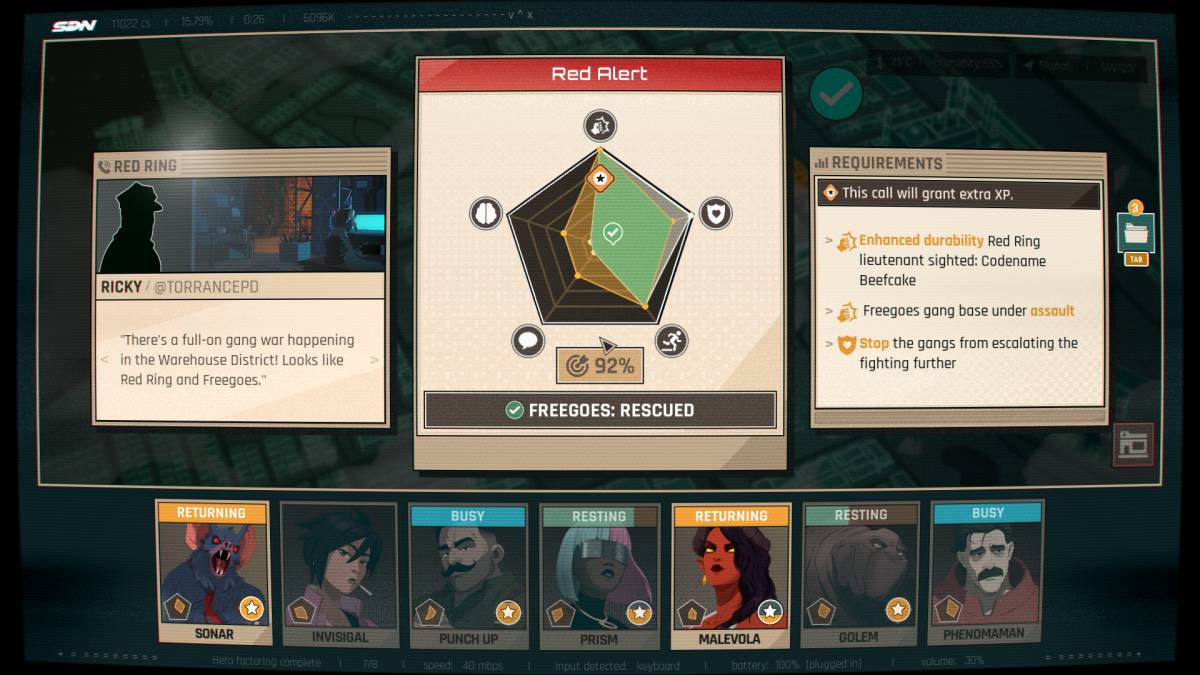
The final segment involves you hacking various software by completing various puzzles. While these puzzles have some interesting challenges, they don’t stand out as much as the other gameplay segments and are honestly quite forgettable.
Dispatch feels like a season of modern television which serves as both a pro and con. The game’s dialogue has a unique, natural flow that allows it to stand out from other games while having some of the funniest quips of the year. However, like modern television, it suffers from the lack of time required to develop the story to make it feel complete.
For example, a major aspect of the game’s story revolves around redeeming former villains/criminals. Very few of those characters go through a redemption arc to earn their spots as heroes, while the game portrays Robert proving himself as a leader to earn his team’s trust. Some characters on the team, like Golem, didn’t require a redemption arc, many team members felt like they needed one or more backstories.
The only two characters who go through a sort of redemption arc are Flambae and Invisigal. The former only occurs if certain choices are made and the latter starts off really well for the first six episodes until the last two episodes drop the ball. Invisigal is one of the game’s two potential love interests for Robert alongside his boss Blonde Blazer.
The fans of each character have stirred a large debate online over which love interest is better., As a Demi-Romantic Asexual, I don’t care much for romance options in video games. These two are walking red flags who I wouldn’t recommend dating based on their current state in the game’s story. If they had to be implemented, I’d rather have the pool of potential partners be larger to include more options and relationship dynamics.
On the topic of love and romance, the game has a large amount of nudity and sexual content which made me uncomfortable personally. While you have the option to turn on an in-game censor, these scenes still happen. Besides, the game gives enough context clues to what is happening in these scenes for players to piece it together, whether they want it to or not.
The finale overall suffers from a lack of a strong ending, or rather endings. In narrative-choice driven games, multiple endings are a necessity. The player’s choices should have a major impact on how their story ends, with varying boons and consequences the player receives that are balanced throughout each ending.
But in Dispatch’s main two endings, the player’s boons and consequences are vastly unbalanced. One being an obvious failure and the other an obvious success with little to no consequences. While this could be to help a possible season two of the game be implemented more naturally in the future, as of right now it leaves the game feeling unbalanced.
The game’s story is at its best when it lets the characters hang out and vibe. Robert’s house warming party in Episode 6 is honestly my favorite part of the whole game alongside the scene of the team grabbing fast food at 3 a.m. in Episode 5.
This game’s cast is great, not just the heroes in The Phoenix Program ,but also the other coworkers at SDN. It’s just a shame that the game doesn’t balance their screen time equally.
My final big praise of this game is its voice acting. Each actor does an amazing job delivering their character’s lines regardless of role size. The main highlights include Aaron Paul as Robert Robertson, giving an unrecognizable performance that sold me on his potential as a voice actor; and Charles White Jr. (Moist Cr1TiKaL) as Sonar, who provides some of the funniest quotes in the whole game.
Other highlights include Laura Bailey as Invisigal; Jeffery Wright as Chase; Lance Cantstopolis as Flambae; Alanah Pearce as Malevola; along with Travis Willingham as Phenomaman. Matthew Mercer also gives a great performance as the game’s main villain Shroud. However, he is unfortunately a victim of the game’s unbalanced screen time between characters and receives nowhere near as many speaking lines as he needed.
Overall, while the game has a problem with balancing screen time and giving storylines time to develop fully, it’s still a fun game with a fun cast of characters who I enjoyed watching interact throughout the game’s story. This game has great vibes that fits a very specific niche for me that very few games have been able to. I’d recommend this game to those who want to have a good time vibing out while having a good laugh.