
College students often are stuck inside their rooms studying away or find themselves feeling alone being away from family.
Unfortunately, I know that feeling quite well as a busy student who is always trying to complete homework on time. It’s exhausting trying to balance work, studying and socializing with your friends. For all of the quarters I’ve been at EvCC, I couldn’t figure out how to feel fulfilled in my college life.
A thought then popped in my mind: Should I adopt a pet?
In a commuter community college, finding the time and place to make friends can be challenging, especially for working students. Working a part-time job on the side while dedicating hours to studying makes a student’s social life limited to these places.
Whether it’s off-campus housing or a dorm, numerous students have stated they often feel bored and isolated. Feeling lonely on campus can lead to a rise of increasing stress and anxiety. According to Psychology Today, two-thirds (64.7%) of a survey of around 1,100 US college and university students have said that they have felt lonely.
Pets, whether they are a cat, dog or a small animal, provide unconditional companionship in their own ways. Interacting with animals has shown to reduce cortisol, the stress hormone in your body. High levels of cortisol have shown to cause weight gain and cause mood swings.
A cat’s purr sends a unique vibration that can help with your stress and even lowers blood pressure. Dogs may help with your physical and mental health. Besides the health benefits, I fully believe that caring for animals teaches responsibility. There is a little animal in your care now — the pet relies on you to live its best life.
I decided that becoming a foster would be the best for me as a student.

The Everett Animal Shelter (EAS) encourages volunteers and foster parents to apply on its website.The shelter usually responds back to the applicant within 48 hours and gets the animals prepared to go. Applicants need to be at least 18 years old, able to start right away, bring the pet back to the shelter for veterinary appointments, keep the animals indoors and follow instructions on any medical care, if needed.
I can set how long I have the animal until it gets adopted and solves the potential issue of flying back home for breaks. The shelter provides the essential supplies and veterinary care, which eases any financial strain when purchasing food or making trips to the vet.
Deciding which foster animal I should apply for didn’t take me very long. I chose the option for adult cats and kittens.
Cats are independent animals that are able to take care of themselves for periods of time, which works with my class schedule and going back to my room to do homework. I highly recommend fostering adult animals if you are gone for periods of time, unless you are up for the rewarding, time-consuming challenge taking care of a kitten or a puppy.
While EAS provides the most essential supplies for the pet, it’s crucial to make your space comfortable and suited for the animal’s needs. Loving my new foster with lots of affection is highly important too. It’s one of the best parts of taking care of animals.
During a shift at work, I finally got my most anticipated email — the shelter needed an adult cat to move to a new foster home. I didn’t even hesitate before saying yes!
My foster cat was a 10-year-old male named Louie. Taking a look at his picture, he is a striking black cat and 11 pounds of fluffy fur. The main reason for his foster status is due to his special prescription diet, as these animals take the longest to get adopted out. Like most senior cats, Louie had early kidney disease but was otherwise healthy.
He had been sent to the shelter after his owner passed away. Since last August, he had been in foster care. Senior cats are also one of the last to get adopted, as they get passed up for kittens who are more appealing for their playfulness. A common misconception of senior cats is that they are not as loving.
Picking Louie up the next day was more than nerve wracking for me. Experience always helps in animal care and I had plenty of years dealing with cat behavior. Yet I couldn’t help but worry I was going to get a fearful cat who wouldn’t trust me. Or that my supplies weren’t enough and more worries just piled on.
Louie was handed over to me in his carrier with a cute floral blanket on the bottom. His large, golden eyes and soft meows warmed my heart immediately.
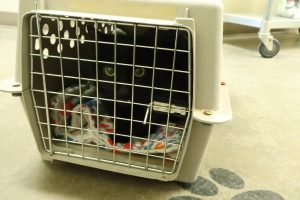
I expected him to act like any other scared cat in an unfamiliar environment – dive under my bed and quiver for a week before getting used to my presence. To my surprise, Louie stuck his head out of his carrier, sniffed around at my belongings and immediately made himself cozy on my pillow.
Seeing his calm, affectionate side made me wonder why so many adopters could pass up on older animals. Senior animals deserve to have love in their golden years as well – Louie did everything to prove that statement right. Despite the hardship he went through, his trust was immediate.
Now with a cat in my daily life, I adapted to a new routine swiftly. Being lazy and sleeping for ten hours a day wasn’t a choice anymore. Louie’s presence quickly shaped my day and made me more aware of my responsibilities. He needed his prescription food, plenty of water and a clean litter box.
Maybe other students do feel this way or they don’t, but I consider myself a lazy college student. Somehow, I didn’t mind these simple chores being tossed into my everyday life. Being with Louie made it all worth it. His companionship made me happier to get back to my room and I just knew he was better off in a quiet place — rather than a noisy, overwhelming shelter.
Getting ready in the morning didn’t seem so dreadful anymore. I wake up to see a curled up cat next to me. My usual makeup routine was getting interrupted by Louie’s paw reaching out for me and his shiny eyes begging me for pets. Being a senior cat didn’t stop him from being affectionate and clingy.
It’s only been a couple of weeks, but I know I will absolutely worry about the day the shelter calls me that someone wants to adopt Louie. There may be a lot of thoughts of keeping your foster, or hesitating to let them go, as “foster failing” a pet isn’t uncommon. However, as a college student who may not be able to afford expensive vet bills or move out soon, I know that Louie’s future owner will be more suited to give him the best life possible. It’s not about what I want, but what is best for the rest of his cat years.
The purpose of fostering is to help an animal unable to adjust to overwhelming shelter life while increasing their chances of being adopted. Fostering helps socialize young puppies and kittens. Animal shelters frequently receive new strays or surrendered pets and some struggle with overcrowding.
Not only does fostering benefit the pet’s well-being, but frees the shelter for newer, possibly injured or sick animals coming in. Emptier shelters ease the workload off of volunteers striving to accommodate every single animal.
If you have the time and resources to foster while in college, take a bit of time to make a difference to an animal’s life. It only starts with a couple of basic supplies and lots of love. Even a small action such as donating supplies or purchasing on an EAS Amazon wishlist can help these sweet animals go a long way.
Donations of eligible items can be left at the shelter’s front porch in their donation bin throughout the week from the hours of 11 a.m. to 5 p.m.
Want to know which items are accepted or not accepted, or want to start getting involved with the shelter? Check https://www.everettwa.gov/148/Animal-Services for all of the important details and applications.